“How’s the quest for an agent going?”
“It’s all right. I’m wondering if I need to trim my manuscript again. I’ve already cut it quite a bit, but some agents are put off by the fact that it’s almost 130,000 words.”
“…Is that a lot?”
The above is a conversation I have a lot, and the confusion is totally my fault because I use a metric to measure my book that’s sort of foreign to the average reader–word count.
Now, let’s give the average reader some credit: they can probably figure out that 8,000 words is too short for a book, and 500,000 words is really long. But most readers think of books in terms of page count, and have a hard time picturing 65,000 versus 90,000 versus 150,000 words. Let’s break it down.
Doing the Math
If the book you’re reading is fiction, written in English, and in standard type (i.e. not a large print book), it probably has about 300 words per page, broken up into roughly 30 lines of 10 words each. If you’re curious about how many words you’re reading, take the page count and multiply it by 300. If you’re wondering how long your friend’s novel is, take the word count and divide it by 300.

This isn’t a perfect science. Pages that start a close chapters tend to be shorter. Pages that feature lots of back-and-forth dialogue may have fewer words. Purple prose with few to no paragraph breaks will have more words. The longer the book, the greater the margin of error, and the less accurate your estimate will be.
If you’re a writer and want to know how many “novel pages” you’ve written, go into Word and change your paper size to A5–that’s the closest size the program has to standard paperback pages.
How Long are Some Famous Novels?
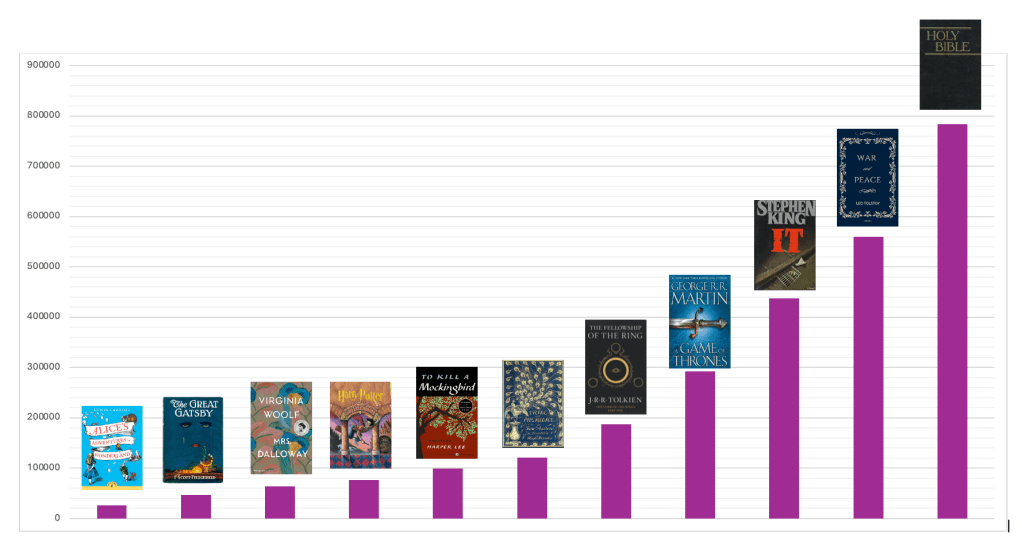
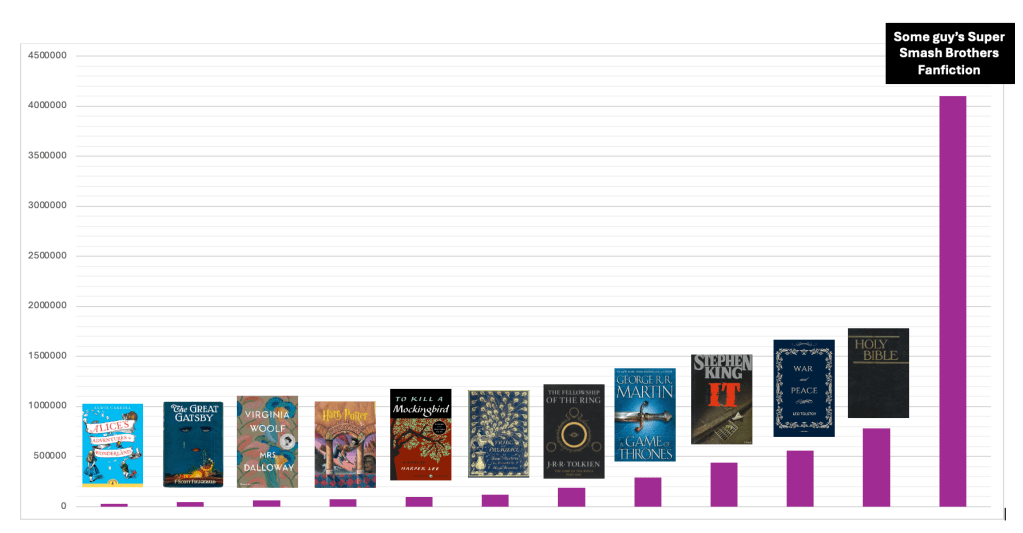
For some, it might be helpful to compare word counts to popular novels. Here are some examples across the spectrum:
- Alice’s Adventures in Wonderland: 26,435 words
- The Great Gatsby: 47,094 words (technically a novella)
- Mrs. Dalloway: 63,422 words
- Harry Potter and the Sorcerer’s Stone: 76,944 words (support Global Action for Trans Equality here)
- To Kill a Mockingbird: 99,121 words
- Pride and Prejudice: 121,342 words (A Court of Thorns and Roses is about 7% longer than this, although I couldn’t find an exact number)
- The Fellowship of the Ring: 187,790 words
- A Game of Thrones: 292,727 words
- It: 437,781 words
- War and Peace: 560,000 – 590,000 words depending on the translation
- The King James Authorized Bible: 783,137 words
- This Super Smash Brothers fanfiction: 4,102,328 words
A short story is about 1,500 – 10,000 words. Stories shorter than that are consider flash or micro fiction.
How Long Should My Novel Be?
Word count norms vary across genres. If you’re writing a horror novel or a romance, publishers look for between 70,000 and 100,000 words (unless you’re Stephen King). If you’re writing sci-fi or fantasy, you can get away with writing over 100,000 words–in fact, some publishers might prefer it! There are other guidelines for if your book is intended for non-adult audiences (ex. middle grade or YA), and I believe picture books have the strictest rules of all.
Average word count for certain genres, according to Reedsy
- Memoir: 80,000 – 90,000 words
- Horror: 70,000 – 100,000 words
- Romance: 80,000 – 100,000 words
- Literary fiction: 80,000 – 100,000 words
- Mystery/Thriller: 80,000 – 100,000 words
- Fantasy/Sci-fi: 100,000 – 115,000 words
For those of us trying to get our debuts published, it’s strongly recommended that we stay within the word count–don’t give an overwhelmed agent or publisher an easy “no” based on the numbers alone! Unfortunately, printing books costs money. Publishers may not be able to convince readers to purchase a super-slim volume, and printing a doorstopper costs more up front than some are willing to risk.
In the end, capitalism was the villain all along.
 Words Per Mile
Leave a comment