
De Selby (Part 1)
De Selby (Part 2)
Hello, and welcome to the first of my eleven(!) essays looking at the influences of Dante in Hozier’s Unreal Unearth album. This album is based on Dante’s Inferno, and the back of the vinyl even indicates which songs correspond to which pieces of Dante and Virgil’s journey. In each essay, I’ll be looking at the song or songs that correspond to those distinct parts, and sharing the thoughts I had and connections I made as I was listening and reading.
As I don’t read Italian (despite Dante’s Italian being very modern for its time), I used a hard copy of Henry Wadsworth Longfellow’s translation of the Divine Comedy. This translation is public domain and available on Project Gutenberg if you’re interested!
The artwork is by French illustrator Gustave Doré, and is found in the physical copies of the Longfellow translation.
All quoted passages are attributed to Dante or to Hozier (hopefully it should be clear which is which) unless otherwise stated.
Anyway, onto the essays.
De Selby part 1 & 2 are grouped together as “Descent.” They correspond to the first three cantos in Inferno, where Dante is lost in the wood and meets Virgil. One of my favorite things about De Selby (Part 1) is Hozier singing in Gaeilge—it brought me to tears when I heard it live. Gaeilge, like Dante at this point in his journey, isn’t fully dead but isn’t among the living, either—we’ll talk more about this in a later part.
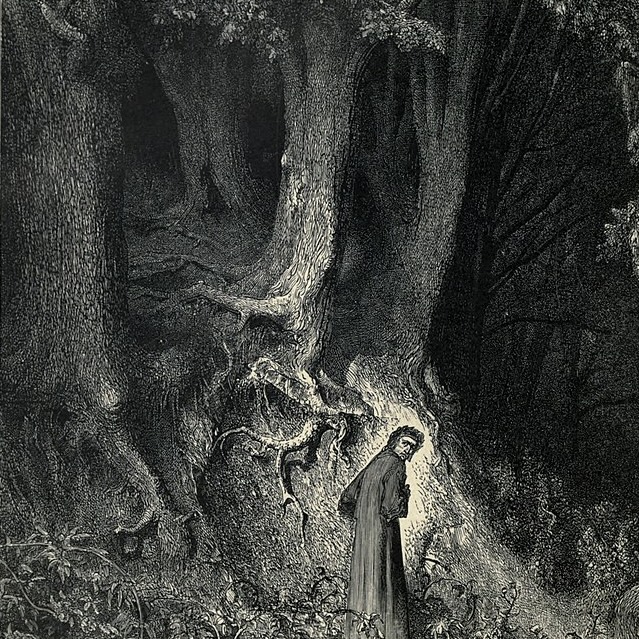
In Part 1, Hozier talks about God creating life because He couldn’t take having all of the empty space, being alone in creation. It’s about God’s and our relationship to darkness, and how it’s a part of us and can also be something we reject. In Inferno, one could interpret Dante’s being lost in the woods as a sort of darkness—perhaps doubt or some other distance from God. His mind rejects this nothing in-between, and who comes to save him from this purgatory but Virgil.
Virgil, one of the most renowned and influential poets in the Western canon, is an idol of Dante’s and becomes his guide throughout the rest of the poem. The end of th Gaeilge passage in Part 1 is as follows:
Is claochlú an ealaín
Is ealaín dubh í
Art is a transformation
It is a dark art
Throughout the rest of the poem, the artist Virgil will help Dante transform his ideas of Heaven, Hell, and man’s relationship to God.
The titles of these first two songs also reference The Third Policeman by Flann O’Brien. While I haven’t read the novel (yet), it’s similar to Inferno in that it follows the journey of a man through Hell and the afterlife. As O’Brien (actually a pseudonym for Brian O’Nolan) once said:
“When you are writing about the world of the dead – and the damned – where none of the rules and laws (not even the law of gravity) holds good, there is any amount of scope for back-chat and funny cracks.”
While neither the Divine Comedy nor Hozier’s album are laugh-fests, I can see the connection to O’Brien/O’Nolan’s work. (I’d like to draw some kind of connection between there being two sides to De Selby and to the author of The Third Policeman having two names, but I think Hozier just had a lot of music in him to write.)
What about Part 2? My interpretation is much shorter, as De Selby (Part 2) seems to be mostly about crossing the Styx into Hell.
And unto him the Guide: “Vex thee not, Charon;
It is so willed there where is power to do
That which is willed; and farther question not”
Noncommittal souls live outside the gates of Hell, not even going far enough to truly reach the afterlife. Dante and Virgil must pass them, and Virgil must order Charon to let them cross the Styx, before they fade away into the blackness of the world of the dead.
However, I don’t think Charon or Virgil is the “you” in the lyrics. The passages in question are the only time Dante’s love, Beatrice, is mentioned by name in Inferno, and it’s her desire to save Dante from sin that starts him on his journey and motivates him to carry it through. Beatrice wants Dante to survive and return to her in Heaven, and so he does—“if you want it done.”
That’s all for the descent. Next week, we get properly into the first circle of Hell. Is there anything I missed, or anything you want to add? Leave a comment below!
 Words Per Mile
Leave a comment