
“That is another question that will remain unanswered: I feel as though I am made of nothing else.”
-Jacqueline Harpman
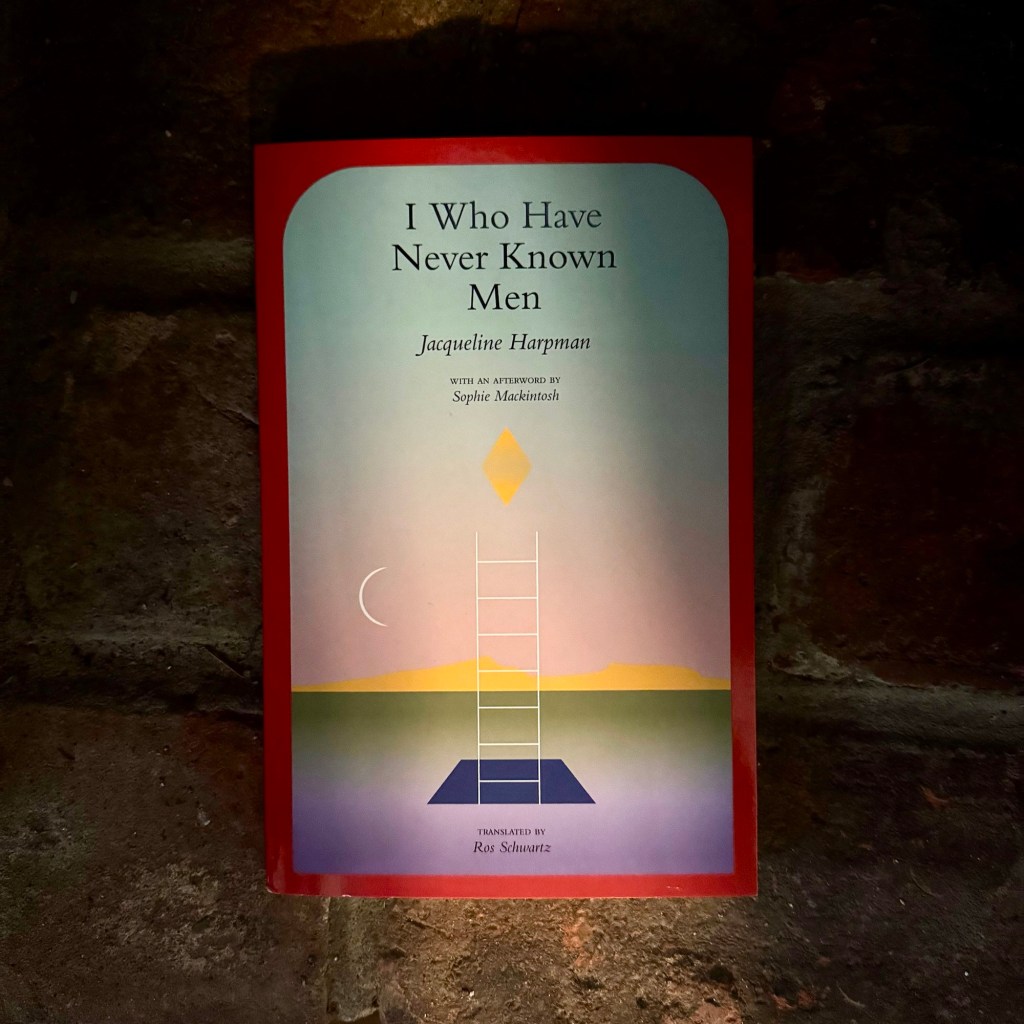
I devoured this little novella in one sitting. I’m a sucker for a good survival story, and lately I’ve been loving works where female gender plays an important role. You can guess the latter from the title of Harpman’s work, although, unexpectedly, female isn’t set in opposition to male, but rather framed as important in isolation, a key part of the narrator’s identity even though she has little to contextualize it with or compare it to. I thought this was an interesting, refreshing way to use gender in a novel.
I say “refreshing” as if the novella has just come out, and in fact I was surprised to see it was published in 1995–only some of the jobs mentioned give a hint that it’s not more recent. I do think it’s a work that’s truly timeless, thanks in large part to how much time and context is stripped away from the narrator.
What does it mean to be a human when you’re stripped of context, culture, and your most essential relationships? The narrator has no immediate family, no peers (she’s the youngest of her group by at least 10 years, as far as I can tell), and no chance to develop romantically or sexually–it’s even noted in the novel that, despite aging from child to adolescent to adult, she never menstruates.
What she does have is a sense of injustice and a desire to learn–human embellishments on the fundamental natural phenomena of aggression and curiosity. An animal can be aggressive or curious, but it’s the narrator’s shaping of her identity–what little she can make of it–around these concepts that makes her human. There are many questions left unanswered at the end of the novel, but I find the ambiguity strengthens the portrait of this unnamed character (and doesn’t detract from my enjoyment of the worldbuilding).
On Harpman’s writing style, I think it says a lot that this 99-page novella has, at the time of writing, 236 quotes on Goodreads. I wish I could read it in the original French, but Ros Schwartz does an excellent job with the translation and the loveliness and stark haunting quality of the prose really comes through. It’s hard to read and hard to stop reading. I also greatly appreciated Sophie Mackintosh’s afterword, and highly recommend picking up a copy with it included. Learning about some of Harpman’s early life experiences redoubles the gut punch of I Who Have Never Known Men and makes it sing that much more true.
 Words Per Mile